Why Your Car Slams Into Gear During Hard Acceleration

You’re merging onto the highway, pressing the accelerator to match traffic speed, when it happens. The engine revs, the transmission kicks down, and instead of a smooth surge forward, you feel a sharp, unsettling thud. It’s the kind of moment that makes you wonder if something just broke. The reality is that this symptom is common, especially in higher-mileage vehicles. The key is understanding what’s happening inside the transmission and what that harsh shift is trying to tell you.
What’s Actually Happening Inside Your Transmission
Under normal conditions, an automatic transmission is designed to deliver power smoothly, even during aggressive acceleration. When you press the throttle hard, the transmission responds by downshifting to a lower gear. This allows the engine to operate in a higher power band. At the same time, the torque converter manages the transfer of engine power to the transmission, smoothing out the transition. Hydraulic pressure, controlled by the transmission’s internal system, engages the appropriate clutch packs to make the shift happen seamlessly.
There’s an important distinction between a firm shift and a harsh one. Some vehicles, particularly those with performance tuning, are designed to shift more firmly under load. This can feel more direct or even slightly aggressive, but it’s controlled and consistent. A harsh shift, on the other hand, feels abrupt and unrefined. It’s often accompanied by a jolt that seems out of proportion to the driving input. That difference matters because it helps separate normal behavior from a developing issue.
Many transmission problems don’t show up during routine driving. Around town, with light throttle input, the system isn’t under much stress. Components can compensate for minor wear or inconsistencies. But when you demand full power, hydraulic pressure increases and timing becomes more critical. Any weakness in the system becomes more obvious. That’s why a transmission can feel fine most of the time, yet act up dramatically when pushed.
The Most Likely Culprits Behind That Jarring Shift
The first place to look is the transmission fluid. Low or degraded fluid is one of the most common causes of harsh shifting. Transmission fluid isn’t just a lubricant. It’s also a hydraulic medium that enables precise pressure control. When the fluid is old, contaminated, or at the wrong level, it can’t maintain consistent pressure. This leads to delayed or uneven clutch engagement, which you feel as a slam into gear. Checking fluid condition is a simple step that can rule out a major category of problems early.
If the fluid is in good condition, the issue may be mechanical. Clutch packs inside the transmission wear over time, especially if the vehicle has been driven hard or has high mileage. As these components degrade, they don’t engage as smoothly as they should. At the same time, shift solenoids, which control the flow of hydraulic fluid, can begin to fail. A solenoid that sticks or responds too slowly disrupts the timing of the shift. Instead of a controlled engagement, the transmission snaps into gear.
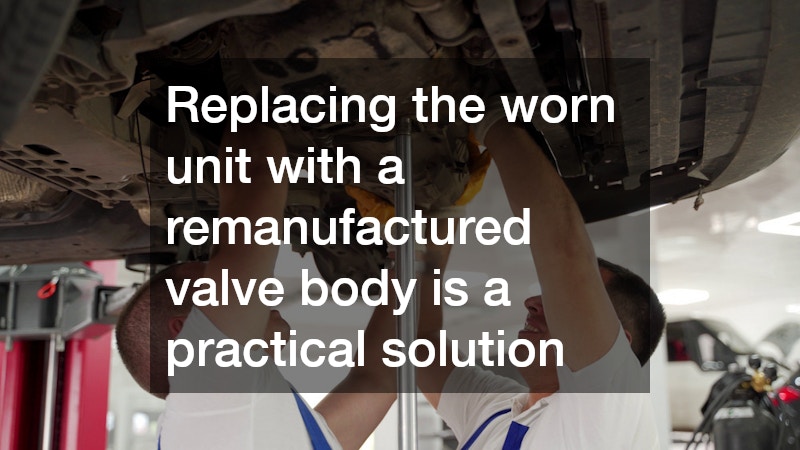
Another common source of harsh shifting is the valve body. This component acts as the control center for the transmission’s hydraulic system. It directs fluid through a network of channels to manage pressure and shift timing. Over time, internal wear can cause issues like pressure loss, sticking valves, or inconsistent fluid flow. When this happens, even a well-maintained transmission can develop harsh shifting characteristics. In many cases, replacing the worn unit with a remanufactured valve body is a practical solution. It restores proper hydraulic control without the cost of a full transmission rebuild.
Diagnosing and Deciding What to Do Next
If your vehicle is showing these symptoms, a proper diagnostic is the next step. A qualified shop will typically start by inspecting the transmission fluid for level, color, and contamination. From there, they may use a scan tool to check for stored fault codes and monitor real-time data from the transmission system. Pressure testing can reveal whether the hydraulic system is operating within the correct range. Finally, a road test under load helps replicate the issue and confirm the diagnosis.
The range of potential repairs can vary widely. In some cases, a fluid and filter change is enough to restore normal operation, especially if the issue is caught early. If components like solenoids are failing, targeted replacement may resolve the problem. More advanced wear, particularly within the valve body or clutch packs, may require more involved repairs. At the far end of the spectrum is a full transmission rebuild or replacement. The earlier the issue is identified, the more likely it can be addressed with a simpler and less expensive fix.
Before authorizing any repair, it’s worth asking a few key questions. Is the issue caused by general wear or a specific failed component? Are there alternative repair options, such as remanufactured parts, that could reduce cost without sacrificing reliability? What kind of warranty is offered on the work? Clear answers to these questions help you make informed decisions and avoid unnecessary expenses. A good technician should be able to explain both the problem and the reasoning behind their recommended solution.
That jarring moment during hard acceleration isn’t random. It’s a signal. The transmission is responding to stress in a way that reveals underlying issues. Hard acceleration puts every component under maximum load, making it one of the most effective ways to expose problems. Drivers who pay attention to these changes and act early are far more likely to avoid major failures. What feels like a sudden shock is often an early warning, and one worth taking seriously.